There is a quiet, specific moment that happens in the life of a diver. It rarely happens during the adrenaline of certification or the excitement of a first shark encounter. It usually arrives on a slow, unassuming dive—perhaps near the end of a trip, when the brain stops chasing highlights and simply settles into the rhythm of the water.
You are drifting along a reef you have seen a dozen times before, but suddenly, the lens shifts.
You notice a coral head that was vibrant neon last season is now a ghostly white. You see a patch of sand, previously pristine, now suffocated by a tangle of fishing line. You watch a turtle glide past, not just as a beautiful creature, but as an individual bearing a fresh scar on its flipper.
In that instant, a fundamental psychological shift occurs. You stop being a tourist consuming a view, and you start being a witness to an ecosystem.
Most divers assume that to move from "witness" to "guardian," they need a formal invitation. They believe they need a marine biology degree, a scientific diver qualification, or flawless buoyancy skills before they are allowed to help. They feel unsure, inadequate, and unprepared.
This belief is the single greatest barrier to marine conservation.
The reality is that the moment you began noticing was the moment you became qualified to start. Conservation diving isn't a club for experts; it is a mindset for the observant.
The Myth of Expertise
When beginners imagine conservation, they visualize a high-tech operation: experts in matching rashguards carrying clipboards, laying transect tapes, handling complex research equipment, and speaking in Latin names. This image is intimidating. It suggests that until you are "good enough," you are a liability.
However, the marine science community knows a secret that recreational divers often don't: Science cannot be everywhere.
- Scientists are limited by funding and grants; they cannot be in the water daily.
- NGOs cannot afford to survey every reef system in real-time.
- Dive Professionals have a job to do—keeping clients safe—and cannot always focus on data collection.
But recreational divers? They are the only consistent, massive human presence in the ocean.
This makes the beginner diver arguably the most valuable untapped resource in marine protection. The entire entry layer of conservation is not built on PhDs; it is built on presence. The work is designed to teach you as you do it, not before you arrive.
Step One: The Art of Deliberate Movement
If we strip conservation diving down to its absolute skeleton, the first meaningful contribution has nothing to do with planting coral or tagging sharks. It is entirely behavioral. It is the shift from accidental movement to deliberate presence.
Scientific studies on diver impact consistently show that damage is rarely intentional. It is the result of a fin tip brushing a fan coral, a hand steadying itself on a rock, or silt kicked up by flutter-kicking near the bottom.
Therefore, the first act of a conservation diver is to master spatial awareness.
The Conservation of "Not Touching"
When you decide to perfect your buoyancy not just for safety, but to protect the reef, you are actively conserving it. When you learn to frog kick to avoid disturbing sediment, you are protecting the corals from suffocation.
This sounds trivial, but it is the cornerstone. Once you learn to inhabit the reef without disturbing it, you have crossed the most important threshold. You are no longer part of the background pressure degrading the site. You have created a "neutral impact" baseline, which allows you to move on to positive action.
Turning Observation into Action
Once a diver masters their own space, the "noticing" that began their journey starts to demand action. The ocean becomes personal. The shift from passive observer to active participant doesn't happen in a classroom; it happens on the dive boat.
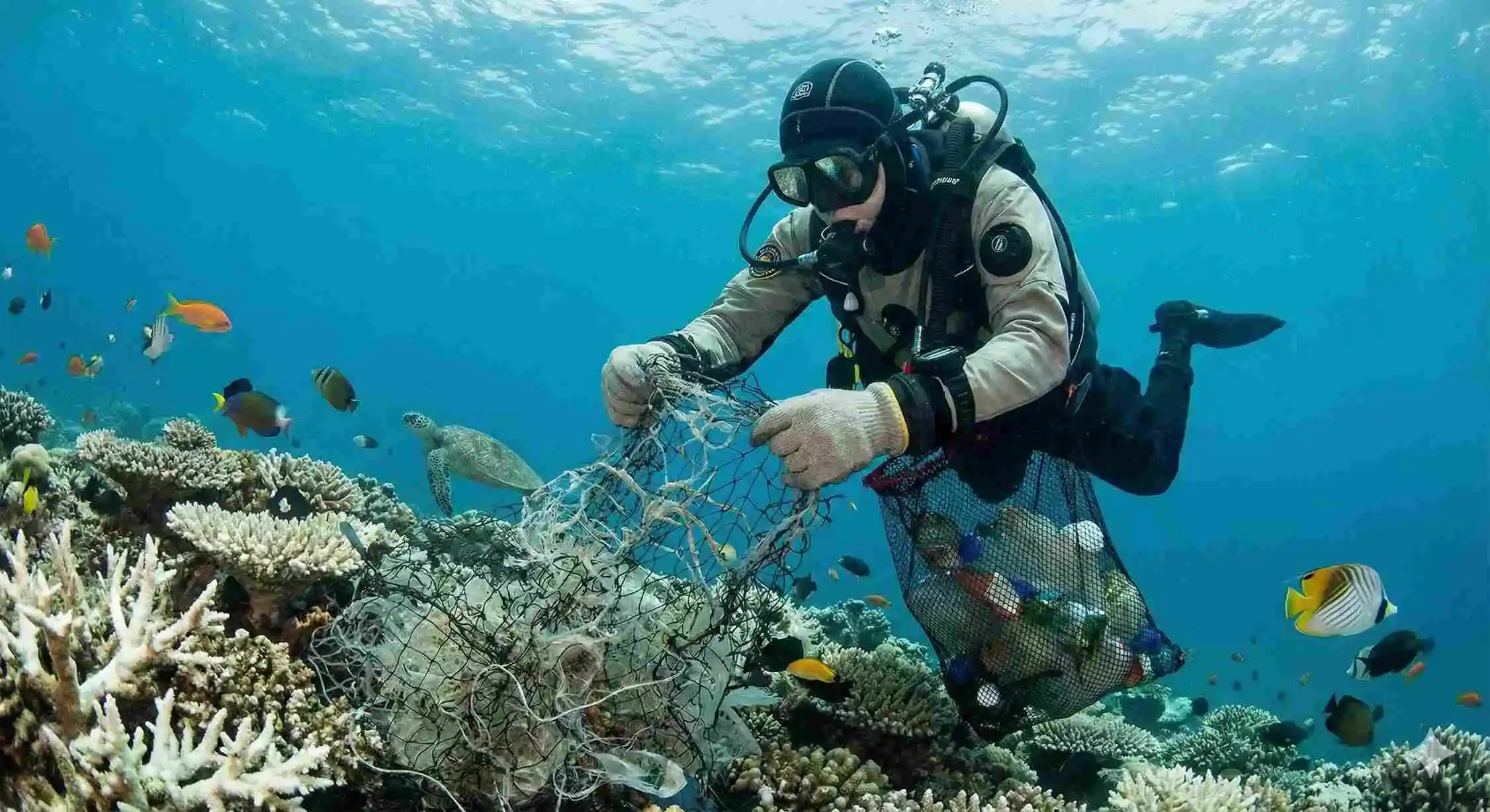
It starts small. You see fishing line caught on a branching coral, and because you now trust your buoyancy, you carefully remove it. You see a plastic bag floating mid-water, and instead of swimming past, you pocket it.
But it goes deeper. You start to realize that your eyes are data collectors.
- You report a ghost net to the dive shop.
- You notice a Crown-of-Thorns starfish outbreak and alert the guide.
- You tell the boat crew that a specific anchor buoy is dragging and damaging the reef.
None of this requires a certification card. It requires the confidence to say, "I saw something, and it matters." This is the moment a diver realizes that conservation is not an extracurricular activity—it is an integral part of diving itself.
Documentation: The Beginner's Superpower
There is a misconception that "real" data only comes from scientists. In the modern era of Citizen Science, this is false. A beginner with a GoPro is often more valuable than a scientist who isn't there.
Photography is the bridge between tourism and science.
- Identification: A photo of a manta ray's belly markings can be uploaded to global databases to track migration and population health.
- Timelines: A video of a coral patch taken during a heatwave provides proof of bleaching events that researchers can analyze later.
- Health Tracking: A photo of a shark with a hook in its mouth or a turtle with fibropapillomatosis (tumors) provides health data for that region.
You do not need to know why the coral is sick or where the manta is going. You just need to be the person who documents that it was there. Your proximity is your qualification.
Choosing the Right Environment to Grow
Perhaps the most actionable step a beginner can take is choosing who they dive with.
You cannot learn conservation in a vacuum. If you dive with a center that treats the reef like a playground, handles marine life, and ignores buoyancy limits, you will unconsciously adopt those norms. Conversely, if you choose a dive center that integrates conservation into their daily rhythm, you will absorb those habits effortlessly.
Look for a dive culture that:
- Includes environmental tips in every dive briefing.
- Enforces a strict "no touch, no chase" policy.
- Treats buoyancy control as a mandatory skill, not an optional one.
- Participates in local monitoring or cleanup projects.
In this environment, conservation isn't a special event; it's just "how we dive." You don't have to force your way into the world of conservation; you simply join a community where the standards lift you up.
The Truth About "Being Ready"
The transition from recreational diver to conservation diver is not marked by a ceremony. It is a quiet internal decision.
The moment you become truly useful is the moment the ocean becomes personal enough that you take responsibility for it. A diver who feels responsible learns faster. They ask better questions. They care about currents and water temperature not just for comfort, but because they understand how these factors affect the reef.
By the time a beginner reaches this mindset, they are no longer a beginner in the way that matters.
People do not enter conservation diving because they are qualified. They become qualified because they enter. The ocean does not need you to be perfect. It needs you to be present, aware, and willing to act in the small moments when most others look away.
If you can do that, you have already started. The rest is just deciding how far you want to go.
The Bridge Between Intent and Action
We established earlier that the environment you dive in matters more than your certification card. But for most beginners, finding a dive center that genuinely practices conservation—rather than just marketing it—is the hardest part of the journey.
This is exactly why we built DivePurpose.
We recognized that while many divers are ready to move from "tourist" to "participant," they often lack the connection to the operators who facilitate that shift. We built our directory to solve that visibility gap. DivePurpose exists to connect you directly with dive shops that integrate marine conservation into their daily operations, in whatever form that takes.
Whether you are looking for a holiday center that funds local reef protection, a shop that runs weekly debris cleanups, or a specialist team conducting scientific surveys, our platform makes those options visible. We are not here to dictate which path is "pure" enough. We are here to ensure that when you decide to turn your diving into a contribution, you don't have to guess where to go—you have a map to find the people who are already doing the work.