If you've been diving for more than a few years, you've probably seen the shift.
Reefs that used to be full of branching coral are now patchy, with more rubble and algae. Fish that used to be common feel rare. You hear about bleaching in the news, but you also see it under your own mask.
Globally, scientists estimate 30–50% of coral reefs have already been lost to a mix of warming, pollution, destructive fishing and physical damage.
Since early 2023, a record-breaking heatwave has pushed around 84% of the world's reefs into bleaching conditions, making this the most severe global bleaching event ever recorded.
So if you're a diver who loves the ocean, it's normal to land in this uncomfortable space:
"I want to help. I just don't know where to start – or what actually matters."
The rest of this article is about that gap. Not everything a diver can do is equal. Some things are symbolic. Some things are logistics. Some things move real numbers.
Below is a practical map of where divers are already contributing in meaningful ways – built from actual practice, not wishful thinking – and how you can plug in at different levels of commitment.
1. Looking after the reef itself: restoration, predators, and health
A big share of conservation work now happens at reef level: nurseries, restoration, and targeted interventions.
Coral nurseries and restoration
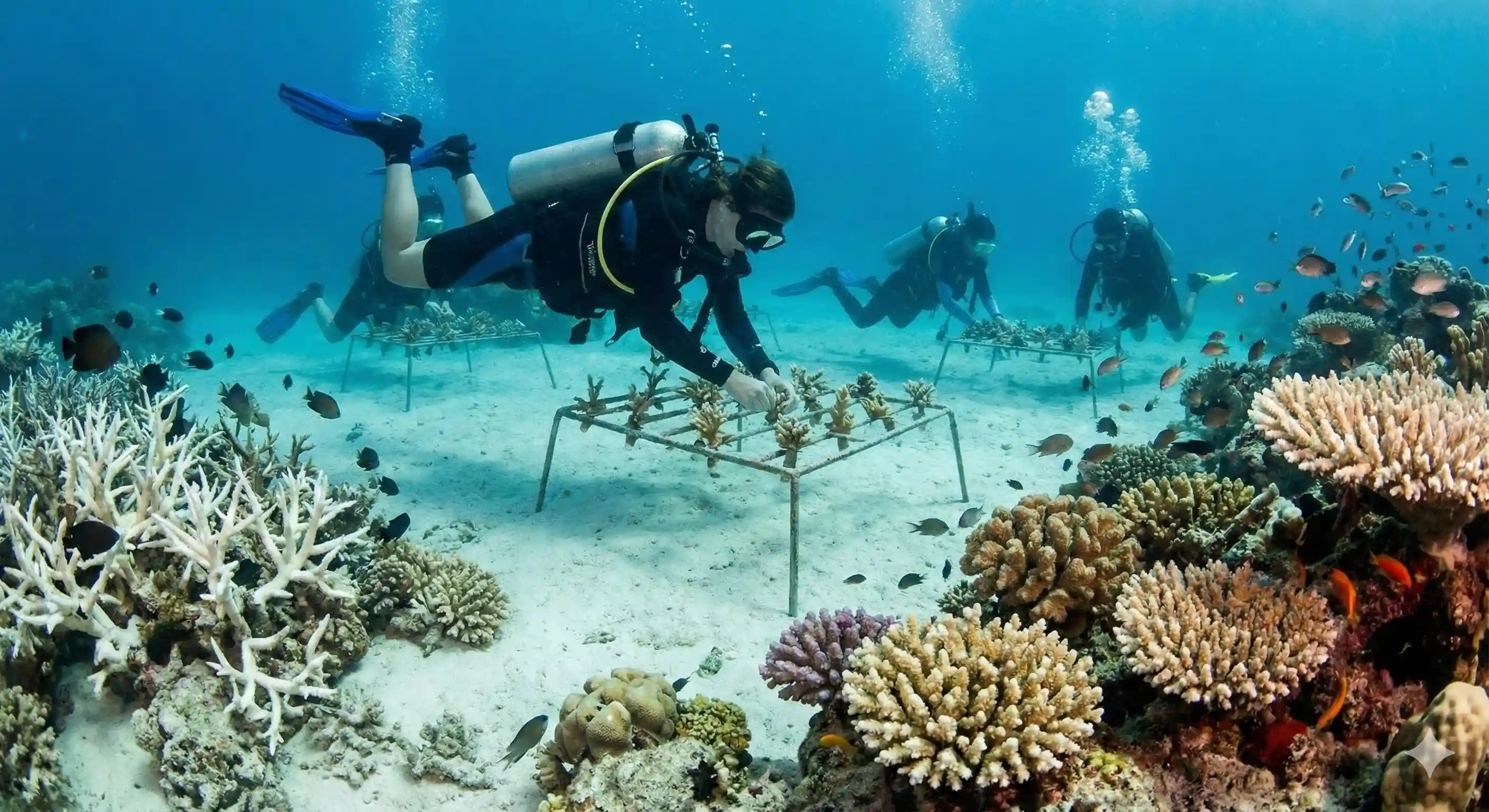
In many places, damaged reefs are now being supported by "coral gardening": fragments are grown on underwater racks or ropes, then reattached to the reef once they're strong enough. NOAA, for example, describes how these projects are being used to help reefs that have already lost a significant share of their cover and are unlikely to recover on their own.
What divers actually do on those projects looks very concrete:
- Cleaning algae and sediment off nursery structures
- Cutting and mounting coral fragments
- Re-attaching fragments to the reef with epoxy or ties
- Swimming fixed transects to record survival and growth
You'll see courses and programs like Reef Check EcoDiver, Ocean Gardener coral restoration courses, PADI Coral Restoration or AWARE Coral Reef Conservation built around this kind of work. The science design usually belongs to local biologists; divers provide the hands, eyes and air.
Interestingly, a 2024 study on coral restoration volunteers found that divers who joined these projects already cared deeply about reef threats – but still reported learning new, specific information about coral ecology and climate as a result of their participation.
In other words: restoration isn't just planting coral. It's also education that tends to radicalise people in a good way.
Predators, outbreaks and "small ugly jobs"
On some reefs, certain species become a problem when other stresses are high. Classic examples are Drupella snails grazing coral or crown-of-thorns starfish (COTS) outbreaks on Indo-Pacific reefs.
Divers get involved by:
- Counting and mapping outbreaks
- Removing snails and small invertebrate predators by hand
- Injecting COTS with approved solutions where that's part of a sanctioned control program
None of this is glamorous. It's hands in rubble, boring transects, repetitive removal. But in the places that run these programs seriously, it's part of keeping specific reef patches alive long enough for the larger climate and policy work to have a chance.
2. Cleaning up what shouldn't be there: debris and ghost gear
The ocean is full of things that were never meant to be there: bottles, fishing line, nets, ropes, anchors.
Some of this is annoying. Some of it is lethal.
Everyday underwater clean-ups
On the simplest end, many dive centres run regular cleanup dives:
- Picking fishing line off coral heads
- Removing cans, bottles, tyres and random junk from the bottom
- Sorting, weighing and reporting what was pulled up
These activities feed into debris databases and help local authorities understand what's washing in where. It's not going to fix climate change – but it directly reduces entanglement and smothering on the sites you actually dive.
Because the skills needed are basic (good buoyancy, a cutting tool, a mesh bag), this is often the lowest-friction entry point for a new purpose-driven diver.
Ghost nets and heavy gear
At the harder end of the spectrum is ghost gear – lost or abandoned fishing nets and lines.
The World Wildlife Fund estimates that ghost gear makes up at least 10% of all marine litter, which translates to around 500,000–1,000,000 tonnes of fishing gear entering the ocean each year.
Recovered nets can contain tens of thousands of dead or dying animals. One documented removal of 870 nets off the US Pacific coast found over 32,000 animals trapped inside.
Removing this gear safely requires:
- Planning (currents, depth, entanglement risks)
- Training in cutting and lifting techniques
- Lift bags and proper surface support
That's why most organised ghost-net projects use experienced divers, often technical or commercial teams. But they also rely on recreational divers to spot, mark and report gear in the first place. Even that simple "I saw a net here, depth X, coordinates Y" can be the start of a removal operation.
3. Turning what you see into data: citizen science and field research
One of the biggest constraints in marine science is simply not knowing what's happening where, often enough. Ships and autonomous vehicles are useful, but they can't replace thousands of divers in the water every day.
That's where citizen science comes in.
Structured monitoring: surveys and protocols
There are several long-running programs that train divers to collect standardised data:
- Reef Check – trains recreational divers as "EcoDivers" to run fixed reef surveys on fish, invertebrates and substrate. The data plug into national and global reef status reports.
- CoralWatch – gives divers and snorkelers a colour chart to record coral bleaching levels, used by researchers to ground-truth satellite temperature alerts.
- Regional projects that log fish abundance, invasive species, seagrass health or microplastic presence.
A 2020 study on diver-led monitoring found that, when protocols are simple and training is clear, volunteer divers can collect data of comparable quality to professionals, and that diving experience didn't significantly reduce data quality once people were trained.
That matters, because it means citizen science isn't just a feel-good add-on. It's a genuine data source for management.
Lighter-weight citizen science: photos and simple logs
Not every diver wants to memorise fish codes or run a transect. That's fine. There are lighter entry points:
- Submitting ID photos of mantas, whale sharks, turtles or sharks to central databases
- Logging unusual sightings (e.g. range extensions of species) through platforms like iNaturalist
- Recording simple coral colour observations for bleaching tools
These inputs feed into models of migration, site fidelity, population trends and bleaching severity, which in turn influence MPA design, fishing closures and tourism rules.
The important part: you don't need to be a biologist. You need a camera, some discipline around how you take the photos, and a habit of submitting them.
4. Standing on the side of wildlife: megafauna projects and rescue
For many divers, "why I care" is a manta, a shark, a turtle.
There's a whole layer of conservation that revolves around those animals – not just because they're charismatic, but because their health is a proxy for the wider system.
Monitoring mantas, sharks, turtles and whale sharks
The structure is similar across projects:
- Divers photograph the animal's "fingerprint" area (belly spots, fluke shape, facial scutes, etc.)
- The image is uploaded with time and location
- Software and researchers match it against a catalogue
Over time, those records show which cleaning stations are critical, where migration corridors run, which areas are nurseries, and how tourism is affecting behaviour. That information then underpins arguments for protected areas, speed limits, no-go zones or seasonal closures.
From a diver's perspective, it's an easy add-on to a normal dive: take the right photo, from the right angle, without chasing or harassing the animal.
Entanglements and emergency response
The more serious side is entangled or injured animals.
Here, the most realistic roles for an ordinary diver are:
- Recognise and correctly report the situation (photos, location, severity).
- Avoid impulsive rescue attempts that could make things worse (for you or the animal).
- Plug into local networks that coordinate trained response teams.
In some regions, experienced divers receive specific training on turtle or mammal disentanglement. In others, that work is handled by specialised NGOs or government units. Either way, good information from the water is what triggers the response.
5. The boring, powerful lever: how and where you spend your money
There's one piece of the puzzle that doesn't require any extra skills, gear or courses:
Choosing where you dive, and who you give your money to.
Recreational diving isn't harmless by default. Studies have shown that on heavily used reefs, diver contact can significantly reduce coral cover and change the community structure over time. One study in Thailand found that about two-thirds of observed divers broke coral fragments during a dive, mostly through fin kicks and poor control.
The difference between "tourism as damage" and "tourism as funding" is how operators behave and what rules exist.
What you want to encourage:
- Shops that use moorings instead of dropping anchor on reefs
- Briefings that actually mention buoyancy, distance from coral and animal behaviour
- Group sizes that match the conditions
- Waste rules on boats (no plastic bottles, no trash overboard)
- Clear "no feeding, no chasing, no touching" policies
- Involvement in local monitoring, cleanups or education
Frameworks like Green Fins were built to make this concrete: they provide a 15-point environmental code of conduct and regular assessments for dive and snorkel operators.
For you as a diver, this means two things:
Ask harder questions before you book.
- "Do you participate in any monitoring or restoration projects?"
- "How do you manage waste and plastics on your boats?"
- "Do you follow Green Fins or similar guidelines?"
Reward good practice with your bookings and your reviews.
A positive review that mentions conservation efforts is a small but real signal inside a very competitive market.
From a Purpose Driven Diver perspective, this is the baseline: Even if you never join a project, the way you choose operators can still shift money toward people who are helping rather than quietly eroding the reef they sell.
6. Choosing your first step (by friction, not by guilt)
Looking at all of this at once can be paralysing. Coral, nets, data, megafauna, internships, politics – it's a lot.
The simplest way to move is to choose your first contribution by friction level, not by drama.
Lowest friction (you can start on your next dive):
- Cleanups with a local shop
- Submitting ID photos or simple bleaching observations
- Asking your operator about their environmental practices and choosing accordingly
Medium friction (requires a bit of planning or training):
- Short coral restoration or monitoring courses
- Joining a structured citizen-science survey weekend
- Volunteering with a local NGO while you're in one place for a week or two
High friction (life-phase choices):
- Multi-week internships
- Combining Divemaster training with conservation work
- Tech training for deep net and debris work
You don't have to jump straight to the deep end. But it helps to know the map so you understand what you're building towards.
7. What "purpose driven diving" really is
Underneath all the programs and acronyms, the pattern is simple:
- You already see what's happening underwater.
- You choose to act on that information, instead of treating it as background sadness.
- You pick a role that fits your current level of skill, money and time – and you do it properly.
That might be one cleanup dive every trip. It might be two weeks dragging nets with a specialist team. It might be a lifetime of submitting manta IDs from every holiday.
All of that is valid.
The point of something like DivePurpose / PDD is not to tell you which path is "pure" enough. It's to make the first useful action obvious, and then give you more options once you're ready.