Most divers believe their impact on the ocean begins when they roll backward off the skiff. They assume their contribution to reef health is measured by how perfect their buoyancy is, or whether they pick up a piece of plastic drifting past them at 15 meters.
But this is not where the impact begins.
The most critical moment for the reef does not happen underwater. It happens weeks or months earlier, in front of a laptop, with a credit card in hand.
It happens when you decide who you are going to dive with.
This sounds like an exaggeration, but when you strip away the romance of exploration and look at the hard mechanics of marine tourism, the truth is unavoidable: A reef is not shaped by the behavior of a single diver. It is shaped by the operational culture of the businesses that bring them there.
A coral reef can withstand typhoons. It can withstand heat waves. But it cannot withstand the daily, grinding attrition of a dive operation that views the ecosystem as a product to be consumed rather than a home to be visited.
The difference between "tourism that degrades" and "tourism that protects" often comes down to the logo on the boat. This is the hidden power of the booking button.
The Mechanics of Destruction: How "Fun" Shops Kill Reefs
To the untrained eye, almost all dive operations look the same. There are tanks, boats, briefings, and bubbles. But below the surface, the difference in impact is staggering.
Many "general fun" dive shops operate on a volume model. Their goal is to get as many divers as possible into the water as quickly and cheaply as possible. This business model creates a specific set of destructive behaviors that are often invisible to the average guest:
1. The Anchor Chain Radius
A conservation-minded shop will invest time and fuel to find a mooring buoy or drift the boat. A volume-focused shop will often drop an anchor because it is faster.
The Reality: An anchor doesn't just hit one spot. As the boat swings with the wind and current, the heavy chain drags across the bottom, pulverizing a perfect circle of coral into rubble. One lazy captain can destroy 50 years of coral growth in a single lunch break.
2. The "Culture of Silence"
This is perhaps the most insidious danger. In many "customer-is-king" shops, dive guides are implicitly trained to prioritize tips over reef protection.
The Reality: A guide sees a guest kneeling on a brain coral to adjust their mask. The guide should intervene. But in a bad shop, the guide worries that correcting the guest will lower their tip or lead to a bad TripAdvisor review. So, they stay silent. The coral dies so the customer doesn't feel embarrassed.
3. The Carrying Capacity Crunch
Every dive site has a "carrying capacity"—the number of divers it can handle before the wildlife flees and the coral breaks.
The Reality: "Fun" shops often ignore this. They will dump 20 divers onto a small pinnacle. The result is a chaotic "fin flurry" where divers jostle for space, kicking delicate sea fans and sediment in the process. The wildlife, stressed by the crowd, leaves the area permanently.
The Trap of the "Eco-Sandwich" (Greenwashing)
As divers become more environmentally conscious, bad operators have adapted. They have learned to speak the language of conservation without doing the work. This is often called the "Eco-Sandwich": a thin layer of green marketing wrapped around a core of destructive practices.
You might see a dive center that sells "Save the Sharks" t-shirts in their retail shop (the green layer) but then allows their guests to chase and harass sharks underwater for Instagram photos (the destructive core).
Common Greenwashing Signals:
- Vague Buzzwords: Using terms like "Eco-Friendly" or "Green" without explaining how.
- Token Gestures: They ban plastic straws (which is good) but anchor their boats on the reef (which is catastrophic).
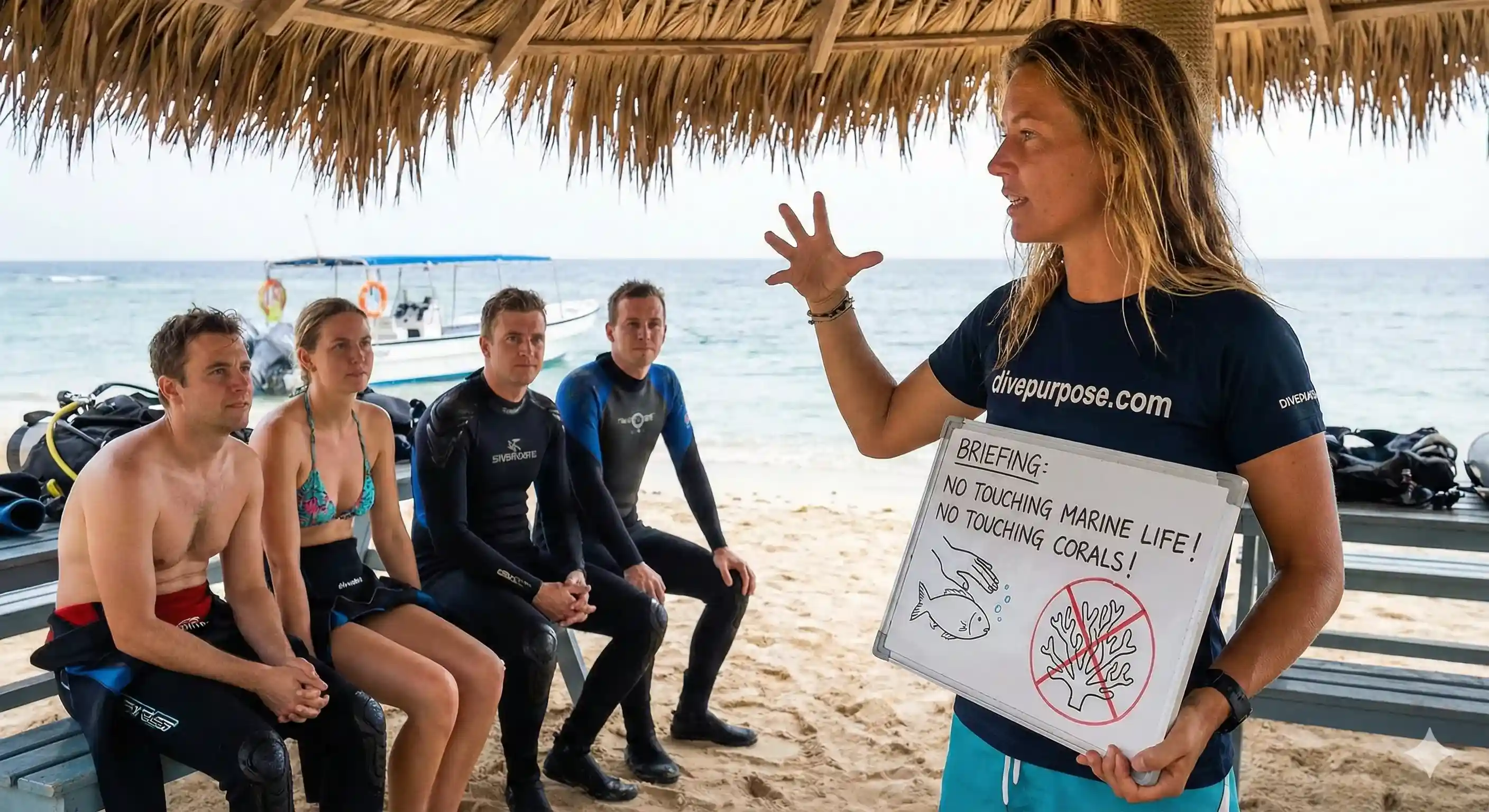
- The "Touch" Policy: They say "don't touch" in the briefing, but the Divemaster is the first one to poke an octopus to make it move for the guests.
The Anatomy of a Guardian: What a Good Shop Actually Does
Conversely, when you choose a genuine conservation-minded operator, you are not just buying a boat ride. You are entering a different kind of behavioral system. These shops act as the immune system of the reef.
Here is what you are actually paying for when you choose them:
1. The Briefing as Education
In a standard shop, a briefing is a logistical checklist: max depth, max time, back on the boat. In a purpose-driven shop, the briefing is a subtle lesson in marine biology and ethics. When a guide explains exactly how to position yourself in a current to avoid grasping dead coral, they aren't just protecting the site for that hour; they are giving you a skill you will keep forever.
2. Political and Economic Pressure
Good dive shops are often the loudest voices in local government meetings. They are the ones fighting against illegal fishing permits, lobbying for marine park patrols, and reporting poachers. Your money funds that fight.
3. The "Strict" Factor
A good shop might feel "stricter." They might ask you to do a check-dive to prove your buoyancy before letting you on a fragile deep wall. They might stop a dive if a guest harasses an animal.
The Shift: Beginners often mistake this strictness for unfriendliness. It is actually the highest form of professionalism. It means they value the ocean more than your ego.
The Economics of Ecology: Your Booking is a Signal
We rarely think of tourism as a political system, but that is exactly what it is. It is a system of incentives. Every dollar spent in the dive industry is a vote. It is a signal sent into the market that tells operators what is acceptable.
When you book with the cheapest shop that runs cattle-boats, you are signaling: "I do not care about the health of this ecosystem; I only care about the price."
When you book with a shop that limits group sizes, refuses to anchor, and funds local marine park fees, you are signaling: "I value the reef more than the convenience."
If enough divers send the second signal, the market shifts. Bad operators are forced to adapt or close. Good operators are rewarded and can expand their protection.
This is conservation at the systemic level. It does not require you to be a marine biologist. It does not require you to spend your holiday planting coral. It simply requires you to direct your resources toward the guardians rather than the exploiters.
The Legacy of a Single Choice
There is a profound relief in realizing this. Beginners often feel paralyzed by the idea that they aren't "qualified" enough to help save the ocean. They think conservation is reserved for scientists and activists.
But the truth is simpler. You don't have to be a conservation expert to protect a reef. You just have to hire one.
By choosing a purpose-driven dive shop, you are outsourcing the protection of the reef to people who are there every day. You are funding the mooring lines that save the coral. You are paying the salaries of guides who stop harassment. You are keeping the lights on for a business that acts as a steward for the ocean.
You can certainly join cleanups, and you can certainly submit data. Those are noble actions. But if you did nothing else—if the only thing you ever did was rigorously choose responsible operators—you would still leave a legacy of protection on every reef you visit.
You are not just buying a dive. You are voting for the future you want that reef to have.
Closing the Gap Between Intention and Action
We know that "choosing the right shop" is easier said than done. The ocean is full of noise, greenwashing is real, and it is difficult to tell from a flashy website whether a dive center truly practices what they preach or if they just use the right buzzwords to sell tickets.
This uncertainty is the exact reason we built DivePurpose.
We realized that thousands of divers are ready to move from "tourist" to "participant," but they lack the map to find the candidates. DivePurpose is that map. We exist to connect you directly with dive shops, liveaboards, and operators that have integrated marine conservation into their DNA.
Whether you are looking for a shop that specializes in coral restoration, a center that runs citizen science projects, or simply a high-quality operator that refuses to anchor on the reef, our directory makes those options visible. We aren't here to judge your journey or dictate which path is "pure" enough. We are here to make your first, most powerful conservation act—your booking—simple, transparent, and impactful.